

Rescue Device Aluminium Tripod for Confined Space Safety in Pakistan

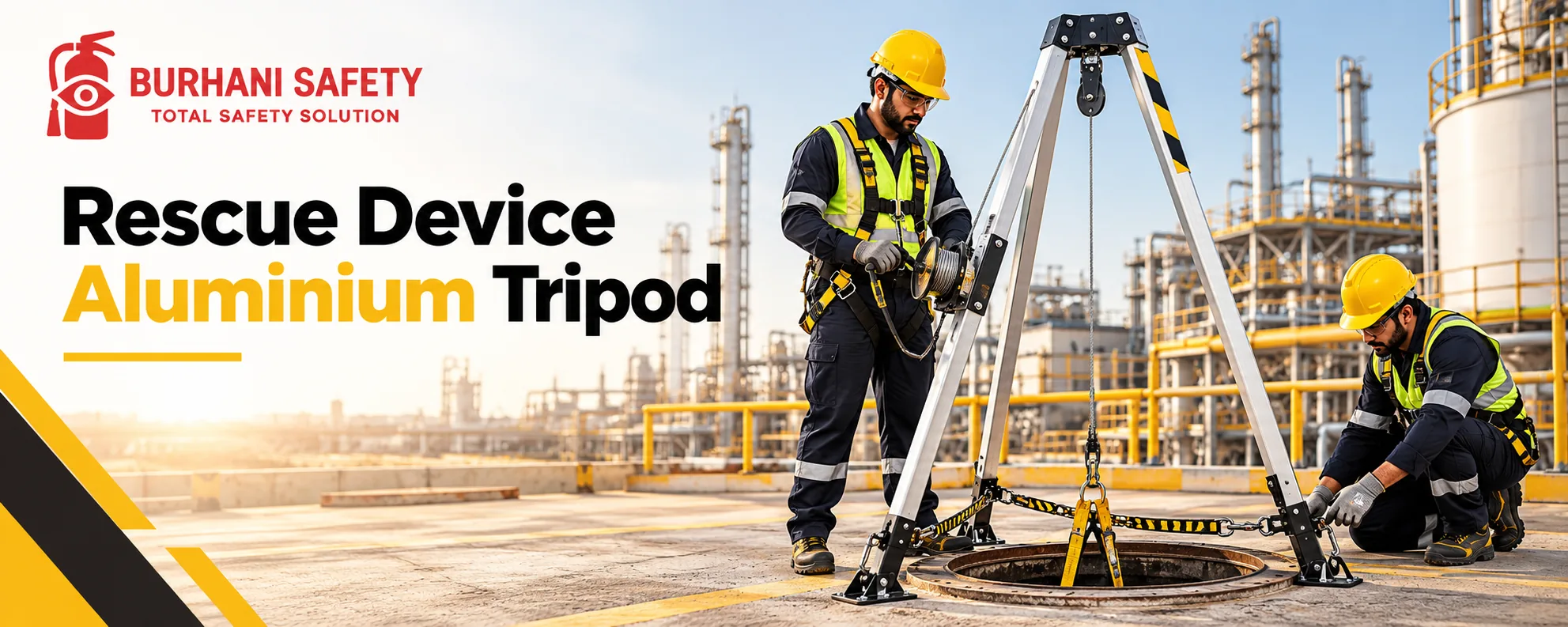
A Rescue Device Aluminium Tripod is an important piece of industrial safety equipment designed to support controlled access, retrieval and emergency rescue operations in confined spaces.
From manholes and underground chambers to tanks, pits, shafts and industrial vessels, confined-space locations can make normal worker access and emergency evacuation difficult. A properly selected aluminium rescue tripod provides a portable elevated anchorage point that can be combined with compatible retrieval equipment such as a rescue winch, lifeline and full-body harness.
For organizations sourcing industrial PPE and rescue equipment, Burhani Safety supplies a broad range of safety equipment for construction, industrial maintenance and commercial applications throughout Karachi and Pakistan.
What Is a Rescue Device Aluminium Tripod?
A rescue device aluminium tripod is a portable three-legged structure positioned above a vertical confined-space opening.
Its main purpose is to provide a stable elevated anchorage point for an appropriate rescue or retrieval system.
Unlike an ordinary commercial tripod, a professional confined-space tripod is designed specifically for safety applications and may be compatible with equipment such as:
- Rescue winch
- Retrieval lifeline
- Pulley system
- Full-body harness
- Fall-arrest device
- Connectors and carabiners
- Anchorage accessories
The exact components required depend on the rescue plan, worksite conditions and manufacturer’s approved configuration.
Professional rescue tripod models are commonly manufactured using aluminium because it provides a practical combination of strength, corrosion resistance and portability.
For example, professional rescue-tripod manufacturers offer aluminium models with telescopic legs and portable anchorage configurations designed for confined access and retrieval applications. Some certified models conform to EN 795:2012 Type B, although certification must always be checked for the exact tripod being purchased.
Why Aluminium Is Used for Rescue Tripods
One of the most important characteristics of a Rescue Device Aluminium Tripod is its construction material.
Aluminium is widely used for professional rescue tripods because it can provide several advantages.
Lightweight Construction
Confined-space equipment frequently needs to be transported from one work location to another.
Compared with many heavier materials, aluminium helps make the tripod easier for trained personnel to carry, position and store.
Good Strength-to-Weight Ratio
A properly engineered aluminium tripod can provide substantial structural strength without unnecessary weight.
The actual safe working load, however, depends entirely on the specific manufacturer’s design and certification.
Corrosion Resistance
Industrial equipment may be exposed to moisture, sewer environments, outdoor conditions and demanding work areas.
Aluminium offers useful corrosion resistance, although all components still require proper inspection and maintenance.
Adjustable Design
Many professional aluminium rescue tripods feature telescopic legs.
This allows trained operators to adapt the system to different access openings and working conditions.
An example from a professional rescue-equipment manufacturer uses aluminium cast and extruded legs with adjustable height for confined access, manholes, silos and trenches.
Rescue Device Aluminium Tripod for Confined Spaces
Confined spaces can present serious occupational hazards.
OSHA defines a confined space as a location that is large enough for a worker to enter and perform work, has limited or restricted entry or exit, and is not designed for continuous employee occupancy.
A permit-required confined space may contain additional hazards such as:
- Hazardous atmospheres
- Engulfment hazards
- Entrapment risks
- Dangerous internal configurations
- Other serious health or safety hazards
You can review the official OSHA Permit-Required Confined Spaces Standard for detailed guidance.
Because emergency access may be difficult, employers need an appropriate rescue strategy before workers enter relevant confined spaces.
Common Applications of an Aluminium Rescue Tripod
A confined space rescue tripod can be used across a range of industrial environments.
Manhole Rescue
Manholes are one of the most common applications for portable rescue tripods.
The tripod can be positioned over the opening to establish an elevated anchorage point for an approved retrieval configuration.
Workers performing underground utility work should also use appropriate PPE. Organizations can explore Burhani Safety’s guide to PPE safety equipment suppliers in Karachi when sourcing multiple categories of industrial protection.
Sewer and Drainage Work
Sewer systems and drainage chambers can contain restricted entry points and potentially hazardous atmospheres.
A retrieval system should therefore form part of a broader confined-space procedure rather than being treated as the only safety measure.
Industrial Tanks
Tank inspection, maintenance and cleaning can require workers to enter spaces where rapid evacuation is difficult.
A rescue tripod can support a suitable vertical retrieval arrangement when approved for the application.
Underground Utility Chambers
Telecommunications, electrical, gas and water infrastructure frequently includes underground access chambers.
These locations may require:
- Rescue equipment
- Gas monitoring
- Communication equipment
- Appropriate PPE
- Emergency procedures
Pits and Shafts
Construction and industrial sites can contain deep pits, shafts and vertical access points.
A correctly selected aluminium rescue tripod may form part of the site’s rescue solution.
Industrial Vessels
Factories, processing plants and other heavy industries may need confined-space access during maintenance shutdowns and inspections.
How Does a Rescue Tripod Work?
A rescue tripod is positioned around or above the access opening according to the manufacturer’s instructions.
The tripod head provides designated anchorage or attachment points.
Depending on the approved system, a compatible winch or retrieval device may then be attached.
The worker may wear an appropriate full-body safety harness, connected to the retrieval system using the attachment point specified for that application.
Burhani Safety offers options such as the Thunder HS-5226 Full Body Harness with 3D Rings for industrial fall-protection applications.
Another option is the TOHO MH-110 5D-Ring Fall Arrest Harness, which Burhani Safety lists with multiple D-ring attachment points for fall arrest and work-positioning applications.
The selected harness must be specifically suitable for the intended rescue configuration. Never assume that every working-at-height harness can automatically be used for confined-space retrieval.
Rescue Tripod With Winch
Many buyers searching for a Rescue Device Aluminium Tripod in Pakistan also require a rescue winch.
The winch can provide controlled movement of the retrieval line where the equipment is designed and approved for that purpose.
A tripod system may contain:
- Aluminium tripod
- Manual rescue winch
- Wire rope or approved retrieval line
- Winch mounting bracket
- Pulley
- Connectors
- Carrying or storage bag
However, not every tripod is sold as a complete kit.
Before purchasing, ask whether the quotation includes:
Tripod Only
or
Tripod + Winch + Cable + Mounting Accessories
This is particularly important when comparing prices from different suppliers.
OSHA Guidance for Confined Space Retrieval
OSHA describes a retrieval system as equipment including elements such as a retrieval line, appropriate chest or full-body harness, and a lifting device or anchor used for non-entry rescue from permit spaces.
Under OSHA 1910.146, employers must evaluate confined-space hazards and provide appropriate rescue and emergency provisions where the standard applies.
The OSHA requirements also specify a mechanical device for retrieving personnel from applicable vertical permit spaces more than 5 feet (1.52 metres) deep.
A rescue tripod therefore should not be viewed as a standalone guarantee of confined-space safety.
Organizations also need to consider:
- Risk assessment
- Atmospheric monitoring
- Ventilation
- Communication
- Trained attendants
- Rescue procedures
- Worker training
- PPE
- Equipment inspection
Rescue Tripod and Full Body Harness
A suitable harness is a critical part of many rescue and fall-protection systems.
For general industrial fall-protection requirements, Burhani Safety also lists a Safety Belt Harness in Karachi for construction and industrial work.
When choosing a harness for a rescue system, verify:
- Manufacturer compatibility
- Harness attachment points
- D-ring configuration
- Harness size
- Webbing condition
- Buckles
- Stitching
- Required certification
- Rescue procedure
For applications requiring multiple attachment points, the TOHO MH-110 5D-Ring Full Body Harness is another fall-protection option available through Burhani Safety.
Features to Check Before Buying an Aluminium Rescue Tripod
Never purchase a rescue tripod solely because it is inexpensive.
Safety-critical equipment needs to match the actual application.
1. Material
Check whether the tripod is manufactured from industrial-grade aluminium or another approved material.
2. Maximum and Minimum Height
Adjustable height affects where and how the tripod can be positioned.
Measure the confined-space opening and surrounding area before selecting equipment.
3. Working Load Rating
Always verify the manufacturer’s specified load capacity.
Do not assume that all rescue tripods have the same rating.
For comparison, commercial professional tripods vary significantly: one manufacturer lists a 200 kg safe working load for a particular aluminium model, while another professional model is rated differently. This demonstrates why the exact data sheet matters.
4. Anchorage Points
Check the number, position and permitted uses of the tripod’s designated attachment points.
Only use manufacturer-approved anchorage locations.
5. Telescopic Legs
Individually adjustable legs can make the equipment easier to position on varying surfaces.
Some professional aluminium systems specifically use separately adjustable legs for uneven terrain.
6. Rescue Winch Compatibility
If you require a winch, confirm:
- Compatible winch model
- Mounting bracket
- Cable length
- Manufacturer-approved configuration
- Maximum working load
7. Portability
For maintenance teams working across multiple locations, transport weight and folded dimensions may be important.
8. Certification
Check the exact certification of the product.
Professional portable anchorage products may be certified to standards such as EN 795:2012 Type B, but not every tripod automatically meets this standard.
Request supporting documentation for the specific product being purchased.
EN 795 and Rescue Tripods
EN 795 relates to anchorage devices used with personal fall-protection systems.
Certain professional rescue tripods are tested and certified as EN 795:2012 Type B portable anchorage devices. For example, both RIDGEGEAR and Abtech list professional aluminium rescue tripods conforming to EN 795 Type B.
However, buyers should avoid assuming that any aluminium tripod sold online meets EN 795.
Ask the supplier for:
- Product data sheet
- Declaration of conformity where applicable
- Manufacturer instructions
- Certification details
- Inspection guidance
Rescue Tripod vs Ordinary Tripod
An industrial rescue tripod and a normal tripod are completely different products.
A normal camera or general-purpose tripod is not designed for supporting rescue or fall-protection loads.
A professional Rescue Device Aluminium Tripod is engineered for safety applications and uses dedicated structural components, anchorage points and compatible rescue equipment.
Never substitute ordinary equipment for a certified safety system.
Importance of Gas Testing During Confined Space Entry
A rescue tripod solves only one part of the safety problem.
Confined spaces may contain atmospheric hazards such as:
- Low oxygen levels
- Excess oxygen
- Flammable gases
- Toxic gases
- Vapours
- Chemical contaminants
OSHA’s confined-space standard requires appropriate testing and monitoring as part of relevant permit-space entry procedures.
Therefore, organizations should conduct the necessary hazard assessment and atmospheric testing before permitting entry.
PPE for Confined Space Work
Depending on the identified hazards, workers may require much more than a tripod.
Typical PPE and safety equipment may include:
- Full-body safety harness
- Industrial safety helmet
- Safety footwear
- Protective gloves
- Eye protection
- Respiratory protection
- High-visibility clothing
- Gas detector
- Communication equipment
- Rescue equipment
For head protection, you can review Burhani Safety’s guide to construction safety helmet suppliers in Pakistan.
Burhani Safety also maintains a broader Protection and Safety Suit category containing industrial and emergency safety equipment.
ISO 45001 and Confined Space Safety
Organizations working in high-risk industrial environments may manage occupational health and safety under frameworks such as ISO 45001.
ISO describes ISO 45001 as an international standard providing a framework for organizations to manage occupational health and safety risks and improve OH&S performance.
You can review the official ISO 45001 occupational health and safety standard information for additional guidance.
Important elements include:
- Hazard identification
- Risk assessment
- Emergency planning
- Worker participation
- Operational controls
- Continual improvement
A rescue tripod should therefore be incorporated into a complete risk-management process rather than purchased without procedures and training.
Inspection of a Rescue Device Aluminium Tripod
Safety equipment should be inspected according to manufacturer requirements before use and at the required periodic intervals.
Typical inspection areas may include:
- Aluminium legs
- Tripod head
- Adjustment holes
- Pins
- Locking mechanisms
- Anchorage points
- Feet
- Leg restraints
- Winch mounting points
- Wire rope
- Connectors
- Harness components
Look for signs such as:
- Cracks
- Distortion
- Excessive corrosion
- Missing components
- Damaged cables
- Loose fittings
- Worn connectors
- Unauthorized modification
If there is any uncertainty about the condition of safety-critical equipment, follow the manufacturer’s removal-from-service and inspection procedures before further use.
Rescue Device Aluminium Tripod in Karachi
Karachi contains a large concentration of industries that may require confined-space and rescue equipment, including:
- Manufacturing
- Oil and gas
- Warehousing
- Port operations
- Construction
- Utilities
- Water and drainage
- Telecommunications
- Chemical processing
- Power and energy
Companies can source complementary industrial protection through Burhani Safety’s PPE safety equipment range in Karachi.
Rescue Device Aluminium Tripod in Pakistan
Demand for confined-space rescue equipment is not limited to Karachi.
Industrial and infrastructure projects throughout Pakistan may require these systems, including projects in:
- Karachi
- Lahore
- Islamabad
- Rawalpindi
- Hyderabad
- Faisalabad
- Multan
- Port Qasim
- Industrial estates
- Power plants
- Oil and gas facilities
Before ordering, send your supplier complete technical requirements so that the correct configuration can be quoted.
What Information Should You Provide When Requesting a Quote?
For corporate and project procurement, include:
- Quantity required
- Required tripod height
- Required load capacity
- Confined-space application
- Winch required or not
- Required cable length
- Required certification
- Harness requirement
- Delivery location
- Project deadline
- Tender specification if applicable
Providing detailed information prevents confusion between a tripod-only quotation and a complete retrieval system.
Why Choose Burhani Safety for Industrial Safety Equipment?
Burhani Safety supplies a broad selection of industrial safety and PPE equipment for businesses and workers in Pakistan.
Available safety categories include:
- Full-body harnesses
- Fall-protection equipment
- Safety helmets
- Protective clothing
- Safety footwear
- Fire-safety products
- Industrial PPE
- Rescue and emergency safety products
Corporate procurement teams can source related equipment alongside their rescue-system requirements.
Frequently Asked Questions
What is a Rescue Device Aluminium Tripod?
A Rescue Device Aluminium Tripod is a portable anchorage structure designed for approved confined-space access and retrieval applications. It is commonly positioned above manholes, shafts, pits, tanks and underground chambers.
What is an aluminium rescue tripod used for?
It can form part of a rescue and retrieval system for workers entering confined spaces such as manholes, sewer chambers, tanks, pits and industrial vessels.
Does an aluminium rescue tripod come with a winch?
Not necessarily.
Some products include only the tripod, while complete rescue kits may include a compatible winch, cable, pulley, brackets and connectors.
Always confirm the package before ordering.
Can a rescue tripod be used for manholes?
Yes, manhole access and retrieval is one of the common applications of professional rescue tripods. Professional manufacturers specifically identify manholes and confined access among typical tripod applications.
Is aluminium suitable for rescue tripods?
Aluminium is widely used by professional rescue-equipment manufacturers because it offers a useful combination of strength and portability. The actual performance depends on the design, testing and certification of the individual product.
Is a rescue tripod required for every confined space?
No single piece of equipment is automatically suitable or mandatory for every confined space.
The rescue method should follow the site risk assessment, applicable regulations, manufacturer instructions and rescue plan.
What certification should I check?
Depending on the project and equipment, buyers may encounter systems conforming to standards such as EN 795:2012 Type B.
Always verify certification for the specific model rather than assuming every tripod meets the same standard.
Do I also need a full-body harness?
Many retrieval systems use an appropriate full-body harness.
You can review options such as the Thunder HS-5226 Full Body Harness available from Burhani Safety.
Compatibility with the actual rescue system must still be verified.
Where can I buy rescue safety equipment in Karachi?
Businesses requiring industrial PPE, fall-protection equipment and rescue-related safety products can contact Burhani Safety in Karachi for product availability and project quotations.
Buy Rescue Device Aluminium Tripod & Safety Equipment in Pakistan
A Rescue Device Aluminium Tripod can be an essential component of a properly planned confined-space rescue and retrieval system.
Before purchasing, compare:
- Material and construction
- Adjustable height
- Working load
- Anchorage points
- Winch compatibility
- Cable length
- Certification
- Portability
- Manufacturer instructions
- Inspection requirements
Most importantly, do not choose rescue equipment based only on price.
A confined-space system should be selected according to actual hazards, entry conditions and the planned rescue method.
For industrial safety requirements, contact Burhani Safety for PPE, safety harnesses, fall-protection equipment and project-based safety procurement in Karachi and across Pakistan.